

TL;DR
- Genuine, unpaid user-generated content (UGC) is a stronger trust signal than paid influencer content because it carries no commercial motive.
- Search engines and LLMs (ChatGPT, Gemini, Perplexity, Claude) both lean heavily on aggregated third-party reviews (Google, G2, Clutch, Amazon, Trustpilot) as core trust signals when ranking or recommending brands.
- In B2B, a named testimonial from a recognised expert client outweighs any volume of paid promotion for building authority.
- In D2C and taste-driven categories (art, food, music, books), UGC directly shapes pricing power and consumer preference.
- The most durable growth strategy is product and service quality that generates authentic UGC, amplified through an integrated content, PR and performance marketing framework, not a testimonials widget bolted onto a homepage.

Marketing conversations used to start with reach: how many people saw an ad, how many clicks it got, how loud a campaign could be. That has changed, especially over the last couple of years. The conversation now starts with trust. And trust, it turns out, is not something a brand can buy, script, or fully control. It is something customers build for a brand, one honest review, one real testimonial, one word-of-mouth referral at a time.
This shift matters more today than ever, because the audience judging a brand’s trustworthiness now includes large language models alongside human buyers. When a prospective client asks ChatGPT to recommend a manufacturing partner, or a shopper asks Gemini which skincare brand is worth trying, the answer these models give is shaped heavily by what real users have said about a brand across the internet, not by what the brand has said about itself.
This article makes the case that user-generated content, UGC for short, is not a tactic sitting alongside SEO, content marketing and PR. It is fast becoming the foundation all three now depend on to earn visibility, and increasingly, to earn a citation inside an AI-generated answer. We will look at why UGC differs fundamentally from influencer marketing, why search engines and LLMs alike lean on reviews as a primary trust lever, and how B2B and D2C brands can build UGC into a genuinely integrated marketing framework rather than treating it as an afterthought on a testimonials page.
Table of Contents
UGC vs Influencer Marketing: A Real Distinction, Not a Semantic One
On the surface, UGC and influencer marketing can look similar. Both feature people other than the brand talking about a product or service. The difference lies in three variables: who is speaking, why they are speaking, and who is paying for it to be seen.
Influencer marketing is, at its core, a paid media channel wearing an earned media costume. A brand identifies a creator with an audience it wants to reach, agrees a fee or a barter (product, experience, commission), and often briefs the tone and even the wording. The opinion may be genuine, but the transaction is commercial, and platforms and regulators increasingly require this to be disclosed.
UGC works differently. A user buys a product, hires a consultant, or completes a project with a manufacturing partner, and chooses on their own to leave a review, post a photo, write a LinkedIn recommendation, or answer a question in a forum. Nobody paid them. Nobody scripted it. That absence of commercial intent is exactly what gives UGC its evidentiary weight, both to other humans deciding whether to trust a brand and to the algorithms trying to detect authenticity.
| Dimension | User-Generated Content | Influencer Marketing |
| Source | Real customers or clients | Paid or gifted creators |
| Payment | Unpaid, unprompted | Fee, commission or barter |
| Message control | None, the brand cannot script it | High, brand usually briefs talking points |
| Perceived credibility | Very high, treated as peer evidence | Moderate, audience knows it is paid |
| Disclosure needed | Not applicable | Mandatory (#ad, sponsored tags) |
| Search & LLM trust weight | High, treated as independent evidence | Low to moderate, treated as marketing |
| Best used for | Trust building, SEO, GEO, conversion | Awareness, reach, product launches |
The nuance worth holding onto is that these are not rivals competing for the same budget line. The smartest brands, in categories like technology and automotive discussed later, now ask creators to use a product genuinely over several weeks before posting, effectively converting a paid placement into a semi-authentic UGC moment. That hybrid is fast becoming its own category: creator-led UGC.
The Power of Real Experience
There is a reason a single detailed one-star review can undo the effect of a beautifully produced advertisement: lived experience carries an evidentiary weight that no creative execution can manufacture. When a real user describes exactly how a CRM implementation went wrong in week three, or exactly how a serum reacted with their skin type, they offer something a brand’s own copy cannot, specificity born of use rather than intent to sell.
This is why category-defining companies, from SaaS providers to boutique consulting firms, have started treating the customer’s actual experience, not the brand’s promised experience, as the primary marketing asset. The gap between the two is where trust is either built or quietly destroyed.
Trusted Feedback, Amplified Through Integrated PR
Feedback in isolation, a single Google review or one LinkedIn comment, is a data point. Feedback woven into a coordinated communication strategy, cited in a press release, featured in a case study, quoted in a founder’s byline article, becomes a narrative. This is where PR and UGC intersect most powerfully.
A well-run integrated campaign takes a strong piece of client feedback and gives it multiple lives: as social proof on the website, as a quote in a press pitch, as evidence in an award submission, and as a citation-worthy fact for content built with LLM visibility in mind. Handled this way, one authentic piece of feedback can influence a buyer’s decision at several different touchpoints without ever feeling repetitive, because each touchpoint presents it in a different context.
The Fundamental Trust Lever for Search Engines and LLMs: Reviews
Search engines have relied on user reviews as a ranking and trust signal for over a decade, ever since Google formalised the idea of E-E-A-T: Experience, Expertise, Authoritativeness and Trustworthiness. Of the four, Experience is the newest addition, and it exists specifically to reward content and entities that demonstrate first-hand, lived use rather than second-hand description.
Large language models have inherited a similar bias, for a straightforward reason. They are trained, and in retrieval-grounded setups, are further anchored, on the same web that Google indexes, plus platforms like Reddit, Quora, G2 and Trustpilot that are unusually rich in first-person, unpaid opinion. When ChatGPT, Perplexity, Gemini or Claude answer a question like which manufacturing partner to use, or whether a skincare brand is worth it, they are statistically more likely to surface entities that appear repeatedly, consistently and positively across independent third-party sources than entities that only appear in their own marketing copy.
This is arguably the single most important operational insight in this article: brands cannot LLM-optimise their way to citation through content alone. They need a visible, consistent footprint of real user feedback across the platforms these models actually draw from.

Localised Search Runs on True User Feedback
For local and hyperlocal search, this dependency on reviews is even more direct. Google’s local search results, the Map Pack and local organic listings, weight review volume, review recency, review rating and review content explicitly in ranking calculations. A manufacturing unit or a wellness studio competing for a near me search is, in large part, competing on the strength and freshness of its Google Business Profile reviews, not on advertising spend alone.
Global Corporate Search and LLM Recommendations Run on the Same Principle
At the global and B2B level, the same dynamic plays out on different platforms. For B2B service and technology providers, Clutch, G2, Capterra and GoodFirms function the way Amazon and Google Reviews function for D2C brands: aggregated, third-party-verified user feedback that both human buyers and AI models treat as more credible than a brand’s own website.
For D2C, Amazon reviews, Trustpilot scores and category-specific platforms, Goodreads for books, streaming and fan platforms for music, TripAdvisor for hospitality, perform an equivalent function.
| Sector | Primary Review or UGC Platform | What It Signals |
| B2B Tech / SaaS | G2, Capterra | Feature satisfaction, implementation experience |
| B2B Agencies / Services | Clutch, GoodFirms | Project delivery, client relationship quality |
| D2C Retail / E-commerce | Amazon, Trustpilot | Product quality, delivery experience |
| Manufacturing / Industrial | IndiaMART, TradeIndia, Google | Reliability, order fulfilment |
| Hospitality / Travel | TripAdvisor, Google, Booking.com | Service experience, value for money |
| Consulting / Professional Services | LinkedIn recommendations, Clutch | Expertise, outcome delivered |
| Automotive | Google reviews, owner communities | Service quality, ownership experience |
Rating Firms and the Feedback Loop Across Sectors
The logic behind formal rating agencies mirrors what happens informally on review platforms: feedback is aggregated, benchmarked, and fed back into the business. An automotive dealership’s after-sales ratings feed directly into staff training and showroom process redesigns. A consulting firm’s client satisfaction scores, often gathered through a formal Net Promoter Score programme, shape how account teams are structured and how junior consultants are trained. A hospitality group’s TripAdvisor and Google ratings inform everything from housekeeping protocols to menu revisions.
This is not a one-way broadcast, it is a loop. Real feedback improves the product or service, an improved product or service generates more positive feedback, and that feedback compounds into a stronger reputation. A few sector snapshots make this concrete:
- Automotive servicing: dealerships that actively track and respond to service ratings tend to show higher repeat-service rates, because the feedback loop catches process failures, such as delayed pickup or unclear billing, before they harden into brand-level reputation damage.
- Consulting and professional services: firms with structured post-project feedback use client comments to refine delivery methodology, not just to collect testimonials, turning UGC into an internal quality function as much as a marketing asset.
- Hospitality and wellness: guest reviews that mention specific staff members or specific service moments are often used in training and recognition programmes, closing the loop between customer voice and staff behaviour.
Awards Systems Run on Client and Customer Feedback
Award programmes, from industry-specific recognitions to global business excellence awards, increasingly build client and customer feedback directly into their judging criteria. Many B2B awards now require submission of client testimonials or third-party review scores as supporting evidence, effectively making UGC a prerequisite for institutional recognition rather than a nice-to-have. This matters for LLM visibility too. Award badges, when documented consistently across a brand’s website, press coverage and third-party listings, add another layer to the entity signals search engines and language models use to verify legitimacy.
For Complex B2B, the Client Is a Thought Leader
In complex B2B categories, engineering, manufacturing, fintech and professional services, buying decisions are made by people who are themselves experts. This changes the value of a testimonial entirely. When a recognised industry expert, a plant head, a CFO, a practising engineer, puts their name and title behind a comment about a vendor, that endorsement functions less like marketing and more like a form of peer certification.
No amount of paid promotion or self-authored content can replicate this, because the value sits not in what is said but in who is saying it and what they are risking by saying it. A named executive attaching their professional reputation to a positive comment about a vendor is making a public, low-frequency, high-credibility statement. Brands that actively and respectfully seek out named, attributed testimonials from recognised experts in their client base build an authority signal that is genuinely difficult for competitors to manufacture quickly.

D2C, Art and Fine Consumption: UGC Shapes Pricing and Preference
On the consumer side, and even more in categories built around taste, art, music, literature, fine food and wellness, UGC does something slightly different: it shapes preference and pricing power at the same time. A restaurant with consistently detailed, glowing reviews can sustain premium pricing that an identical but unreviewed restaurant cannot. An independent author’s book sees a very different sales trajectory depending on organic reader reviews on Goodreads and Amazon. A musician’s streaming numbers respond to fan-generated playlists, reaction videos and social posts far more than to a single paid promotion.
In these categories, buyers are often making a judgment about taste, not just utility, and taste is a domain where peer validation carries more weight than any brand claim ever could.
Even Influencer Marketing Is Pivoting Toward Authenticity
Even within influencer marketing, the centre of gravity is shifting toward authenticity. In technology and automotive in particular, brands increasingly structure partnerships around genuine, extended usage rather than a single scripted post: long-term ambassador programmes, loaner vehicle or device programmes that run for weeks, and creator briefs that explicitly ask for honest pros and cons rather than uniformly positive coverage.
This is a tacit admission from brands that audiences, and increasingly algorithms, can tell the difference between a one-day paid post and content built on real, extended usage. The influencer space is, in effect, trying to borrow the credibility of UGC.
Customer Referrals: The Metric That Links UGC and PR to Growth
Customer referrals sit at the intersection of UGC and business performance, and the link between the two is direct and measurable. A customer who leaves a strong review or testimonial has already, psychologically, taken a public position in favour of a brand. That same customer is measurably more likely to refer the brand to a peer, and referred customers tend to convert at higher rates and lower acquisition cost than customers sourced through paid channels.
When PR amplifies strong UGC, through press coverage, case studies or award submissions, it extends the reach of that referral behaviour beyond the customer’s immediate network, effectively turning one satisfied client into a source of referral-quality trust for audiences that client will never personally reach.
Product Quality Is the Root Cause: The Positive Reinforcement Cycle
It is tempting to treat everything covered so far, reviews, PR amplification, referrals, awards, as marketing tactics. They are not. They are downstream effects of one upstream cause: product and service quality. No content strategy, however well optimised for SEO or generative engines, can manufacture genuine positive UGC out of a mediocre product or an inconsistent service experience. Attempting to do so, through incentivised reviews, review-gating or synthetic testimonials, is both an ethical risk and, given how effective current fraud-detection systems have become across Google, Amazon and G2, an increasingly ineffective one.
The brands that get sustainable value from UGC are the ones that treat quality as the actual growth lever, and content, PR and marketing as amplification of a signal that already exists. This is the positive reinforcement cycle that deserves to be a leadership-level priority, not a marketing team’s KPI alone:
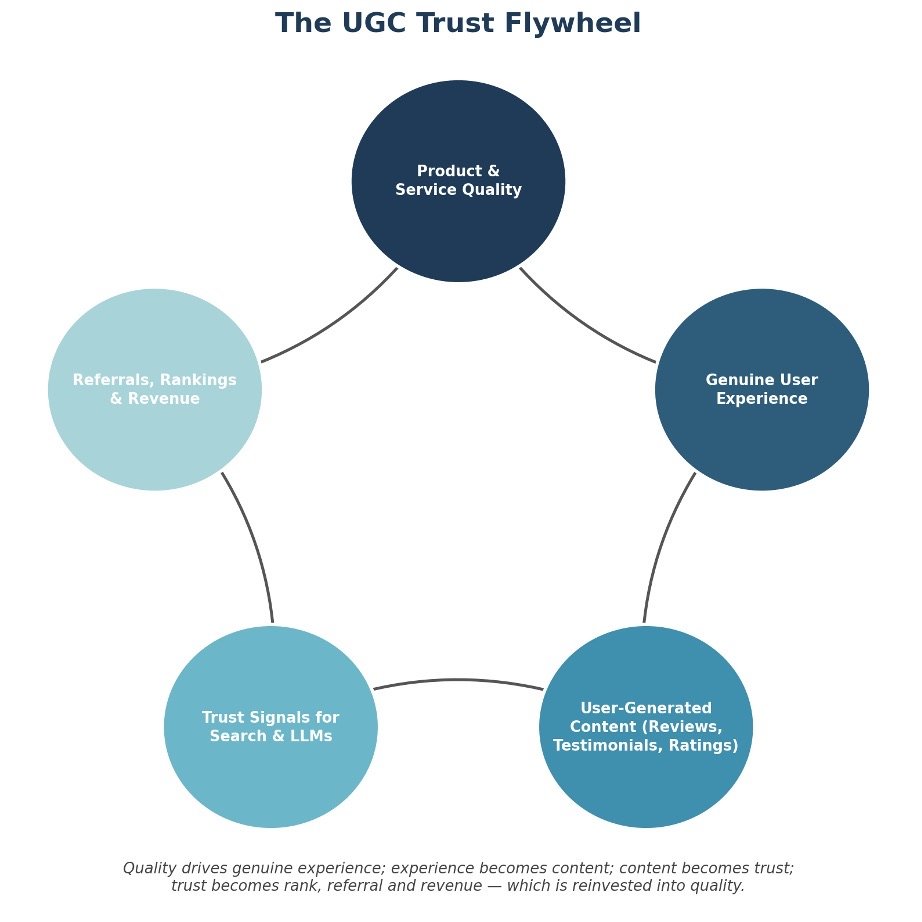
Figure 1: The UGC Trust Flywheel. Quality drives genuine experience, experience becomes content, content becomes trust, and trust becomes rank, referral and revenue, which is reinvested back into quality.
Building the Framework: UGC Inside Integrated Content Marketing
Everything above points to one operational conclusion: UGC works best not as a standalone tactic, a testimonials carousel on a homepage, but as the connective tissue inside an integrated content marketing strategy spanning brand communication, content marketing and PR.
- Brand communication defines the promise and the tone UGC is measured against.
- Content marketing (blogs, case studies, comparison pages, category pages) creates the structured, indexable home where UGC lives and can be cited from.
- PR extends strong UGC into third-party, high-authority spaces, trade press, award bodies, guest features, that neither a brand’s own website nor a review platform can reach alone.
- Performance marketing, SEO and GEO convert the resulting trust signals into visible, ranked, and increasingly LLM-cited, assets.
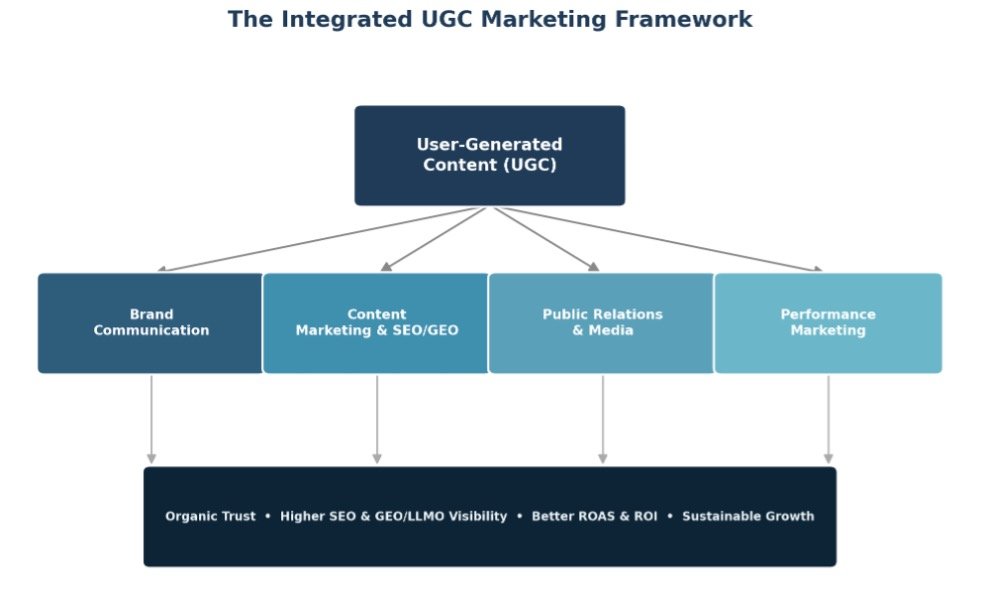
Figure 2: The Integrated UGC Marketing Framework, showing how one UGC signal is distributed across four disciplines to compound organic trust and visibility.
| Segment | What UGC Looks Like | How It Gets Amplified |
| B2B Manufacturing | Client testimonials on efficiency gains, Google & IndiaMART reviews | Case studies, trade press features, Clutch profile |
| B2B Fintech / SaaS | G2 & Capterra reviews, named LinkedIn recommendations | Comparison content, analyst briefings, PR case studies |
| D2C Wellness / Beauty | Instagram UGC, Amazon reviews, before-after content | Influencer amplification of real user stories, blog roundups |
| D2C Consumption (books, music, food) | Reader/listener reviews, delivery app ratings | Media features, curated roundups and playlists |
How the Framework Powers Performance Marketing, SEO and GEO
The commercial payoff of this framework shows up in three places. First, SEO: pages built around real customer language, the actual words clients use in reviews and testimonials, tend to match long-tail, high-intent search queries more naturally than brand-written copy, because they mirror how real buyers actually search. Second, GEO and LLM optimisation: as covered earlier, models weight independently verifiable, repeated positive mentions more heavily than owned content, so a strong UGC footprint across third-party platforms is now a prerequisite for citation, not a bonus. Third, performance marketing: ad creative built around real testimonials and UGC-style formats consistently outperforms polished brand creative on conversion rate and cost per acquisition, because it reduces the perceived risk a prospective buyer feels at the point of decision.
Put together, a brand that treats UGC as infrastructure rather than decoration sees compounding returns across organic search, generative AI visibility and paid performance at the same time.
Actionable Insights: A Practical Starting Checklist
- Audit your review footprint across every relevant platform, Google, Clutch, G2, Amazon, TripAdvisor, industry-specific sites, at least quarterly.
- Build a simple, respectful process for requesting feedback at the moment of highest customer satisfaction, post-delivery, post-project close, or post-purchase.
- Ask satisfied B2B clients for named, attributed testimonials rather than anonymous quotes wherever they are willing to give one.
- Feed strong testimonials and reviews into PR, case studies, award submissions, press pitches, instead of letting them sit only on a testimonials page.
- Write content, blog posts, FAQ pages, comparison pages, using the actual language customers use in their reviews.
- Never incentivise or gate reviews in ways that violate platform policy; treat authenticity as non-negotiable.
- Route review and feedback insights back to product, service delivery and training teams, not only to marketing.
Conclusion
The uncomfortable truth for many marketing teams is that the highest-leverage marketing activity available to a brand today is not a campaign at all. It is the quality of the actual customer experience, because that experience is what becomes the content search engines rank, the evidence LLMs cite, the reference peers use when they refer a friend or colleague, and the proof award panels and rating agencies validate. Content marketing, PR, SEO and GEO are not competing with UGC for budget. Done well, they exist to amplify it.
For B2B and D2C brands navigating a marketing landscape where AI-generated answers increasingly sit between a brand and its buyer, building a genuine, sustained pipeline of user-generated content, and wiring it into an integrated communication strategy, is no longer optional. It is the most durable form of marketing infrastructure a brand can build.
Frequently Asked Questions
What exactly counts as user-generated content in B2B marketing?
Any unpaid, unprompted content created by a real customer, client or user counts, including reviews on platforms like G2, Clutch or Google, LinkedIn recommendations, case study quotes, testimonials, and social posts made without brand compensation.
Does UGC really affect whether ChatGPT, Gemini or Perplexity recommend a brand?
Yes. These models draw heavily on platforms rich in first-person, independently verifiable opinion, such as review sites, forums and Q&A platforms, when forming answers to recommendation-style questions. A consistent, positive UGC footprint across such platforms materially improves the odds of citation.
How is UGC different from influencer marketing?
UGC is unpaid and unprompted, created by real users with no commercial arrangement with the brand. Influencer marketing is a paid or bartered arrangement where the creator is compensated and often briefed on messaging, which both audiences and algorithms weigh differently.
Can a brand incentivise reviews to build UGC faster?
Most major platforms, including Google, Amazon and G2, explicitly prohibit incentivised or gated reviews, and increasingly sophisticated fraud detection makes this a risky shortcut. The sustainable approach is making it easy and natural for genuinely satisfied customers to share feedback.
Why do B2B testimonials from named executives matter more than anonymous ones?
A named, attributed testimonial carries professional reputational risk for the person giving it, which functions as an implicit guarantee of sincerity that anonymous or aggregate ratings cannot fully replicate.
How does UGC connect to SEO and GEO specifically?
UGC provides authentic, natural language and third-party validation that search engines associate with E-E-A-T, and it builds the kind of independent, repeated entity mentions that generative engines rely on when constructing AI answers, making it foundational to both SEO and GEO performance.
What is the single most effective first step for a brand wanting a stronger UGC strategy?
Start with an honest audit of where your brand currently appears in reviews and third-party feedback, then build a simple, non-incentivised process for asking satisfied customers to share their experience at the right moment.
About This Article
This article was researched and written by the team at The Quest Bridge, drawing on current search, AI citation and digital marketing practice. It is intended as a strategic reference for marketing leaders, founders and communication teams at B2B and D2C organisations building or refining their content and trust strategy.
Note and Disclaimer
This article reflects general strategic perspective and does not constitute platform-specific policy advice. Review and UGC practices should always be checked against the current terms of service of individual platforms, including Google, Amazon, G2 and Clutch, which are updated periodically.


